MOOT Learn
No cow. Same milk protein. Read that twice.
This page is the whole argument, in order: how the protein is made, what that puts on the label, and what pouring it actually costs you against what you pour now. The parts that are regulatory fact are cited at the bottom; the brand is the only thing on this page that is invented.
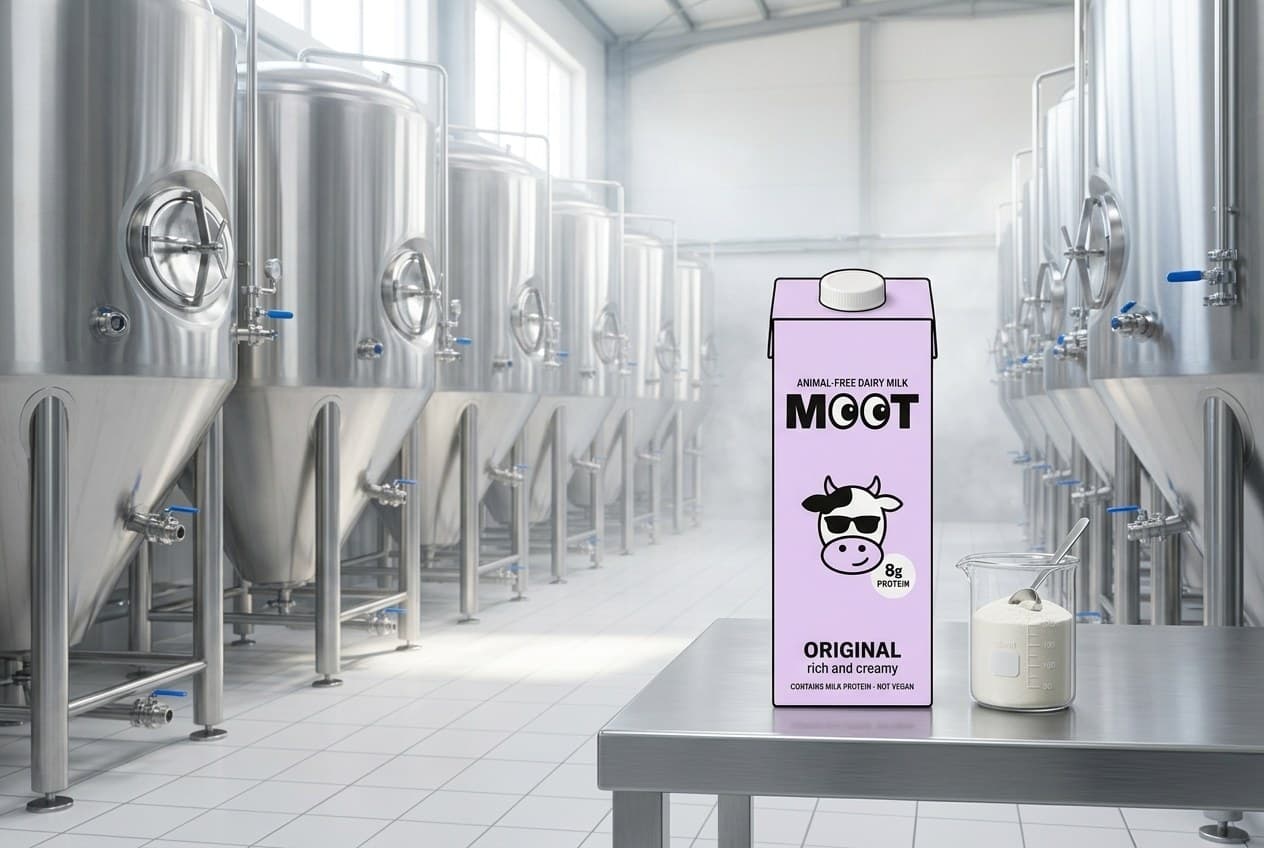
How it’s made
The recipe changes hands
One gene — the cow's instructions for a whey protein called beta-lactoglobulin — is rewritten for a microbe and handed over. Not the cow's DNA in a vat: the recipe, transcribed for a different cook.
The microbe brews it
In fermentation tanks, fed on plant sugar, the microbe secretes the protein into the broth. Same trade brewers have run for centuries; the product is protein instead of beer.
The protein is separated
Filtered out, concentrated, dried. The microbe stays behind in the tank — what leaves is protein powder that is, sequence for sequence, the cow's own whey protein.
Then it's just dairy work
Blended with water, plant fat, sugars, vitamins and minerals into something that froths, bakes and browns like milk — because the protein doing that work is milk's.
The honest version of the catchphrase, while we’re here: it is not “identical to milk”. Milk protein is mostly casein; whey is a fifth of it; this is one protein from the whey — the most abundant one, made exactly, but one. It behaves like dairy because that one protein does a remarkable share of dairy’s work.
The label, unfolded
Nutrition Facts
Calories120
% Daily Value*
*Invented, like the flavour it describes — drawn to the real FDA format so you can see the design carries a true panel, not a photograph of one.
Most of any milk, ours included.
The fermented beta-lactoglobulin. This line is why the allergen statement below exists.
Dairy fat's stand-in — the protein froths, the fat carries flavour.
4 of the 6 grams per glass are added and the panel says so. Dairy's sugar is lactose; ours has none, so sweetness has to be put in.
Calcium, D, B12 — added, exactly as they are added to every other alternative and to most dairy.
Contains: milk protein.
If you have a milk allergy, do not drink this. The protein is beta-lactoglobulin — one of the proteins a milk allergy is an allergy to — and it is the same molecule whether a cow made it or a fermenter did. Your immune system reads the protein, not its paperwork.
This is not our lawyer’s caution; it is federal law. The allergen statute counts as “milk” any ingredient containing protein derived from milk, and the FDA said in writing, when it reviewed this exact ingredient, that it must be declared as one. Lactose-free is true — there is no lactose in it at any point. Lactose-free has never meant allergy-safe, and any carton that lets you blur the two is misdrawn.
The number we won’t print
Every brand in this category leads with an emissions figure. Here is where those figures come from, and why there isn’t one in our hero.
“Up to 97% lower emissions”
A life-cycle assessment prepared by WSP for Perfect Day — the company that sells the protein. ISO-conformant, and commissioned by the party it flatters; its own text says the results can't be extrapolated to production by other means.
WSP for Perfect Day, Inc., Comparative LCA, 20 Aug 2021
“Same order of magnitude as dairy”
The independent, peer-reviewed comparison. Modelled fermented β-lactoglobulin against extracted dairy protein across four countries and found the carbon and water footprints comparable — heavily dependent on the electric grid and the sugar feeding the microbe.
Behm et al. 2022, Int J Life Cycle Assess 27:1017–1034
What drives it either way
In the company's own study, utilities — the study attributes them to the coal-and-gas mix of the US grid — are 40% of emissions, and glucose production is 83% of the feedstock share. A fermenter on a coal grid eating corn glucose is not automatically greener than a cow on grass; it depends on inputs nobody prints on a carton.
WSP LCA 2021; Behm et al. 2022
What we print: nothing
A percentage we didn’t measure, from a study commissioned by the company it flatters, that independent work doesn’t reproduce, is not a fact about our carton. When someone measures ours, we’ll print theirs — with their name on it.
What it actually costs you
The question every page in this category dodges, answered against the published prices of the milks you’d actually be choosing between — oat, almond, soy. Two numbers per row: what the same volume costs, and what 25 g of protein costs. The verdict says who wins each one, in the same voice whichever way it falls.
Priced at $5.49 per 64 fl oz — one retailer's national online listing (Target), Aug 2026 — a shelf price, not a survey.
The one number we cannot know for you. Everything below scales from it.
Your cart is empty, so this is costing the specimen basket: one six-pack of Original, 192 fl oz. Fill a real one and the sheet prices yours.
The sheet
192 fl oz · lasts 2 weeksMOOT192 g protein in the basket
$38.94$5.07Oat milk (Oatly Original)71 g protein in the same 192 fl oz · Oatly's published Nutrition Facts panel
$16.47$5.80Dairy isn't on this sheet on purpose. Conventional whole milk runs about $5.17 a gallon in California (USDA, Sacramento, July 2026) — cheaper per glass and per gram of protein than anything here, ours included. If it works for you, keep pouring it. This sheet is for people who've already stopped.
Comparison rows are published figures with their sources printed; the MOOT rows are as fictional as the brand. Straight shelf arithmetic on the volumes shown — no coupons, no subscriptions, nobody’s “first order” discount.
Why “moot”?
Because that is what the cow’s role becomes, once the protein can be brewed. Not wrong, not obsolete, not the enemy — just no longer the point under discussion. The cow on our cartons isn’t a mascot pretending to be the source; she’s the source, retired, holding a drink she didn’t have to make.
It’s also a small joke about arguments. The oat-versus-almond-versus-soy debate is a debate about substitutes — which compromise you prefer. Brew the actual protein and the debate isn’t won, it’s moot. We put the argument down and kept the milk.
Sources — the real ones
- FDA, Agency Response Letter, GRAS Notice No. GRN 000863 (non-animal whey protein, beta-lactoglobulin by Trichoderma reeseifermentation), 25 March 2020 — including the finding that it “requires labeling under the FD&C Act because it contains protein derived from milk”. A “no questions” letter, which is not an approval, and says so itself.
- 21 U.S.C. § 321(qq) and § 343(w) — the major-food-allergen definition and the declaration requirement (FALCPA, Pub. L. 108-282).
- USDA AMS, Retail Milk Prices Report RMP-0726, July 2026 — Sacramento conventional whole at $5.17/gal, the only California city in the series; the dairy line under the ledger.
- Oatly, Blue Diamond and Silk’s own published Nutrition Facts panels; one retailer’s online listing for each price (Target for oat and almond, Walmart for soy; August 2026) — shelf prices, not a survey.
- WSP for Perfect Day, Inc., Comparative Life Cycle Assessment of Perfect Day Whey Protein Production to Dairy Protein, 20 August 2021 — the company-commissioned study behind the category’s “up to 97%”.
- Behm et al., Int J Life Cycle Assess 27:1017–1034 (2022) — the peer-reviewed comparison that found footprints of the same order as dairy.
- 21 CFR 131.110— the standard of identity that means none of this may simply be called “milk”.
Everything else — the company, the flavours, the prices on our own cartons, the shops — is invented for this demonstration, and the footer of every page says so.