Industriesbakeries and donut shops
Bakery and donut shop website design in Orange County
A morning counter is two businesses sharing one storefront — the walk-in who needs thirty seconds and the office manager who needs four dozen by Thursday — and one page written for the first of them leaves the second with nothing to act on.
A morning counter is two businesses sharing a storefront. One of them is standing outside at ten past six wanting to know what is left; the other is at a desk on Tuesday afternoon ordering four dozen for Thursday. What follows is about what happens when a website is built for the first and the second one has to phone.
Sound familiar?
- Someone drives over at 10:40 for the cinnamon sugar. It went at 9:30, and nothing on your website could have told them.
- An office manager emails Tuesday asking what four dozen costs and how much notice you need. You reply Wednesday night; they booked somewhere else Wednesday morning.
- Your site says you close at one. You are usually empty by eleven, and the people who arrive at noon are annoyed at you rather than at the fryer.
- Big orders come in as a phone call during the 7 AM rush, written on the back of a receipt, and somebody has to remember the rest of it.
- Half of what gets asked at the register is what is left and whether you still have the ube one.
- A caterer asked for a receipt with a tax line on it, and nobody was certain what belonged on it.
- Your website has a gallery and a founder story, and the hours are three scrolls below both.
One storefront, two businesses
Stand behind the register for a morning and you serve two different companies. The first customer wants to know whether you are open, what is left in the case, and where to park. Their whole relationship with your website lasts under thirty seconds and it is finished before nine.
The second is at a desk, is not hungry, and is buying four dozen for Thursday. They need a quantity, a lead time, and something that reads like a promise. That transaction is planned, it is larger, and it is the one that holds up a slow week.
A site built for the first customer is left hoping the second one calls.
The visit that is over in thirty seconds
Are you open, what is left, how far away are you. Two of those three answers change by the hour, and a page typed once cannot keep up with either.
So compute them. Ring Light opens at 5:30 and closes at one o'clock or when the case is empty, whichever comes first, and the demo reads the Costa Mesa clock on the server before the page is sent. Every donut carries the hour it usually goes — cinnamon sugar at 9:30, ube at ten, the raised glazed holding out until noon — so the list at 10:40 is shorter than the list at six. That shrinking list is the entire thing the first customer came for, and it is the one thing the Thursday customer never needs to see.
The part worth copying is what the page does when the shop is shut. It does not grey out. It becomes a pre-order page for the next tray, and the box you fill is held. On its own published hours that shop is closed for more of the day than it is open, and those are the hours in which somebody is deciding about tomorrow morning.
The customer at a desk on Tuesday afternoon
Nothing about this one resembles the other. They are not nearby and not hungry. They have a headcount, a meeting on Thursday and an approval to get, and they will not phone during your rush, because your rush is the one hour nobody can give them a straight answer.
What they need is arithmetic and a deadline. The big-order page turns the first into three dials: how many people, whether you are being polite or honest about appetite, and which mix. The receipt reprints itself on every change — whole dozens rounded up rather than down, with the same dozen rule the single pink box uses applied once per box.
The deadline is the part the page has to say out loud. Four dozen changes the fry plan, so the page states the cutoff, eight at night for the next morning's four o'clock fry, and works out what that means right now. Order at three in the afternoon and it says tomorrow; at nine at night it says the day after, and names the day. Big orders come out from 6:30, once the counter rush has cleared.
Why the big order got its own address
In the demo the planner is not a section of the home page. It is a route, with its own line in the navigation, its own description and its own listing in search. That decision is this whole page in miniature.
A section is something you scroll to. A page is something you send. The office manager forwards a link to whoever signs it off, and what lands in that inbox is a page about feeding a floor rather than a home page about a case of donuts they have to scroll past first. It also lets somebody searching for a big order arrive directly at the thing they came for.
There is a smaller reason worth naming, because it shows the two customers keep different time. The home page refreshes on a fifteen-minute cycle, which is plenty for what is left in the case. The big-order page refreshes every minute, because the sentence it prints changes at eight, and being wrong about that is a broken promise on Thursday.
One price list, two receipts
The two customers need the same numbers presented completely differently, and this is where one generic page fails both at once.
The walk-in wants a single number on a single donut before joining the queue. Ring Light prints it on every card, with the calories beside it — which FDA menu labelling does not require of a one-shop business, since that rule reaches chains of twenty locations or more.
The desk customer wants something closer to a document, because somebody downstream will ask. So the receipt carries a delivery line and a tax line: cold bakery goods sold to go are exempt from California sales tax at one box or at ten, and the demo prints that as zero with the regulation named. At the tables it is 7.75 percent, and the page says the tables are what make it taxable. The coffee traveler keeps its own line for the same reason — one combo price would make the donuts taxable too.
That is the difference between an order somebody can approve at their desk and one that needs a phone call your counter cannot take at seven in the morning.
See it built
Ring Light Donuts is a shop we invented. It is fictional — a Costa Mesa counter that does not exist, with a phone number in the reserved 555-01xx block and an address deliberately placed away from the street where a real doughnut shop trades. We built it a complete working website because the split described above is easier to show than to argue: the case reads the Costa Mesa clock on the server and strikes through what has already gone, and the big-order planner sits at its own address with its own description and its own faster refresh. The tax rules, the calorie figures and the pink-box history on it are real and carry their sources; the shop, its people, its phone and its address are not. Two audiences, two pages, two clocks, one shared box.
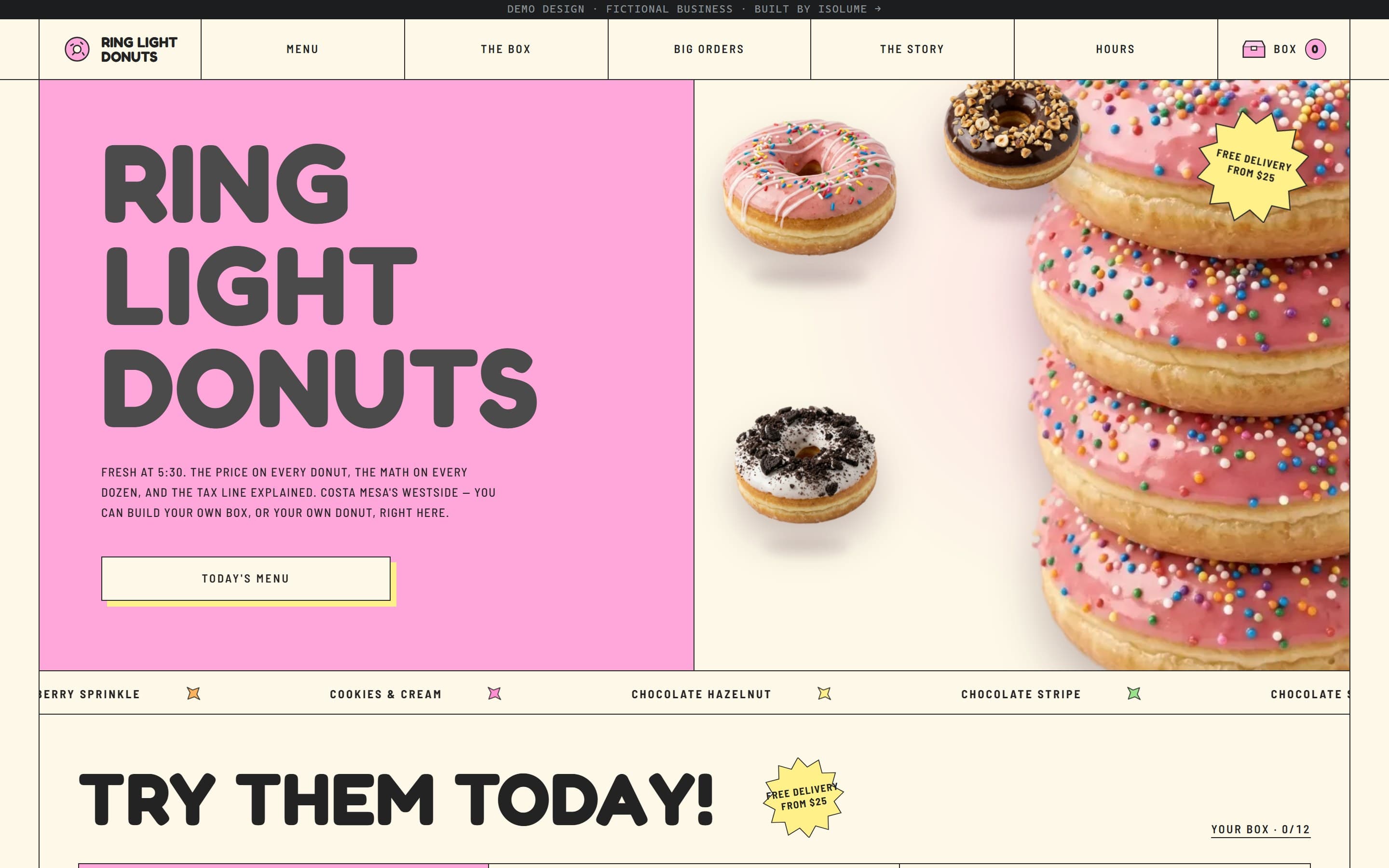
Ring Light Donutsdoes not exist · the website does
Questions we get asked
- How does the website know what is left in the case?
- On a real build it reads your point of sale. On the demo it reads a schedule: every donut carries the hour it usually goes, and the page compares that with the Costa Mesa clock before it is sent. Either is honest as long as you say which one you are doing. What matters is that nobody in your shop should be logging into a website at 9:30 to strike out the cinnamon sugar. If a page needs a person to keep it true, it stops being true by the second week.
- We take big orders on the phone already. Why put a page on it?
- Because the phone is the channel your morning can least afford. A four-dozen order taken at 7:10 competes with a line, gets written on the back of a receipt, and gets remembered wrong. A page that captures the headcount, the mix, the day and the cutoff arrives as a record, at a time when somebody can actually read it. Keep the number on the page, because some people will always call. Stop making the call the only door.
- Do we need online ordering?
- Ask which of the two customers you mean. Walk-in ordering lands in the middle of the 7 AM hour, the one hour of the day nobody can look at a screen, and we would not build it. The four-dozen planner is the opposite proposition: it arrives the night before and gets read with coffee by somebody who has time. Same technology, two different businesses, and only one of them belongs on a morning counter.
- We sell out most days. Won't a website make that worse?
- It changes what selling out costs you. Today the people who arrive after the case is empty leave annoyed, and some of them do not come back. A page that says at ten what has gone, and offers to hold a box for the next tray, turns the same sell-out into tomorrow's order. Scarcity only hurts when it is a surprise. And if you already sell everything you can fry before eleven, then the walk-in page is not your problem and the Thursday order is — tell us that and we will build that page first.
- Is a sales tax line really worth putting on a website?
- It is worth nothing to the walk-in and a fair amount to the office order. Somebody is buying donuts on a company card and will have to explain the receipt to a person who was not there, so a line that reads zero with the regulation named beside it answers a question before it is asked. We are not accountants and yours is worth asking. The point of publishing it is that it can be checked.
Tell us about your bakeries and donut shop
Fifteen minutes on a call. You will leave knowing what it would cost and how long it would take, whether or not you hire us.