Industrieshvac and trades businesses
HVAC and contractor website design in Orange County
The person looking for you is hot, on a phone, and holding two more numbers — so the whole website is really one question: can you come today.
We build sites for HVAC shops, plumbers and electricians in real code, with a fixed quote before anything starts. This page is about what a trades site has to do differently from every other kind of small business site, and almost none of it is decoration.
Sound familiar?
- A caller opens with "you're the third one I tried — you're the one who picked up."
- Your site says 24/7 emergency service. What answers after nine is a voicemail box somebody listens to at six-thirty in the morning.
- A form comes in at eleven at night that says ASAP and nothing else, and it takes two days to get that person on the phone.
- You spend the first minute of too many calls explaining that the address is outside the area you actually drive to.
- You dropped the diagnostic fee in January. The site still quotes the old one, and a customer read it back to you on the phone.
- People call to ask what the diagnostic costs. It is on the site, four scrolls down, inside a paragraph.
The four seconds before she calls the next name
It is a hundred and four degrees, the condenser is silent, and she is in the side yard with a phone in one hand and three shops written down. She wants three things, in this order: can you come today, roughly what is this going to cost, and are you an actual licensed business.
The trade has a house style for the top of a website — a technician giving a thumbs up, and the words Quality Service Since 1987 set into a badge. That is a fine sentence for a truck wrap. It is an answer to a question she did not ask.
So this is a triage problem before it is a design problem. Decide the three answers, put them above everything else, and keep the page light enough to paint on one bar of signal in a side yard. The next name on her list is one tap away.
A site that knows what time it is
The most useful thing a trades website can do is stop being a brochure and start reporting on right now. A banner reading 24/7 EMERGENCY SERVICE over a number that rings a voicemail box until morning costs nothing to type, which is the whole trouble with it. You can find out what it is worth in your own market in about twenty minutes: call three competitors at ten at night and count how many are answered by a person.
The alternative is to compute the answer instead of typing it. Hours live in a schedule pinned to California time, and the page states whether a person is genuinely at the desk. When the shop is shut it says so, names whoever reads the texts in the morning, and turns the loud button from Call into Text. The page never points its biggest affordance at something that will not be answered.
Notice what that costs: an honest site is closed in public. Do the arithmetic on the demo's own hours — six-thirty in the morning to nine at night Monday to Saturday, seven to seven on Sunday — and the shop is shut for nearly ten hours out of every twenty-four. The closed state is not an edge case. It has to be designed, not left as a fallback. A closed sign that tells the truth is the only reason the open one gets believed.
Booking a window the truck can actually keep
A technician's day is a board, not a calendar. Jobs run long, a capacitor turns into a compressor, and a shop that promises 2:15 is promising something the truck cannot deliver. Booking on a trades site should offer what dispatch actually offers: a two-hour arrival window.
Generate the windows rather than listing them. A list written into the page is correct until lunchtime and then starts offering this morning at four in the afternoon. Generated windows carry real lead time and stop offering today when today is gone.
One decision in that flow is worth more than the rest of it combined: ask for the phone number on the first screen, above the street address. Order the fields by what survives being abandoned. A form that takes the number first and then loses somebody at the address has still left you a callable lead; the same form in the other order leaves you nothing. Then keep the phone number under every step, permanently, so the form never becomes a wall between a hot customer and a human.
Meet her at the words she actually typed
Nobody types residential climate control into a phone at ten at night. They type ac blowing warm air, or ice on the copper line, or one room ten degrees hotter than the rest. Those sentences belong on the page as buttons, in her words rather than the trade's.
Two things follow. The page matches the language people bring to a search engine, and the visitor says what is wrong in one tap instead of composing a paragraph one-handed in the heat.
Then put the money beside it. Not a quote — a range drawn from jobs the shop has already done, with one line underneath saying the customer approves a written price before any panel comes off. A flat published price is a number a competitor undercuts line by line and a technician has to defend in a driveway. A range answers the fear without creating either problem, and that fear is the reason she has not called yet.
The section that talks people out of calling you
The strangest section on the demo is a list of four things to check before paying anybody: the breaker, the filter, the thermostat batteries, ice on the line. Two of them can resolve a dead system without a truck.
Publishing that costs money on purpose, which is why it reads as true. It only makes sense if a shop earns more from being trusted than from the calls it just talked people out of.
It can also do real work, depending on the season you are standing in. If your trucks are already booked through a heat wave, the scarce thing is technician hours rather than leads, and a drive that ends at a clogged filter is a drive that did not go to a paying job. In February the same section is pure goodwill. Both are decent reasons to run it.
It has a limit, and the demo respects it — the last check tells you to stop and call. Nothing on a trades site should be coaching a homeowner toward a capacitor that holds a lethal charge after the power is off.
Proof that survives being checked
Badges do not answer are you real. A 500+ Happy Customers graphic is typed by whoever wants one, and there is nothing in it a visitor can check.
Specifics answer it. Instead of the badge, the demo prints a job log: the last eight calls, each with a date, a city, a ZIP, what actually broke, which technician, how long it took, and a permit number on the changeouts. It reads as a record rather than a claim, and it answers do you come to my street with evidence.
The license number works the same way. California requires it, and the classification printed on it names the work the license actually covers — C-20 is warm-air heating, ventilating and air conditioning. Put the number and the class on the page, and on a real shop's build make the number a link into the CSLB lookup so a visitor can read the record without asking you for it. The demo leaves that link off on purpose, because a lookup against an invented license returns nothing.
And when the site answers do you come out here, it should ask rather than guess. An IP lookup will put a homeowner in the wrong city and print it in a headline, and one checkably wrong fact costs every other number on the page its credibility. Five digits typed by the visitor are something true.
See it built
Salazar Air Conditioning & Heating is a business we invented. It is a fictional six-truck HVAC shop in Ontario, California, and we built it a complete working website so that everything above could be shown instead of described — the dispatch strip, the generated arrival windows, the symptom buttons, the published ranges, the job log. It is not a client and never was: the phone numbers sit in the block reserved for fiction, and the license number and the reviews are samples. What the page shows depends on when it loads. The strip reads the clock in Ontario before anything renders, so a visit at eleven at night gets a different headline, a different button and a different first arrival window than a visit at noon.
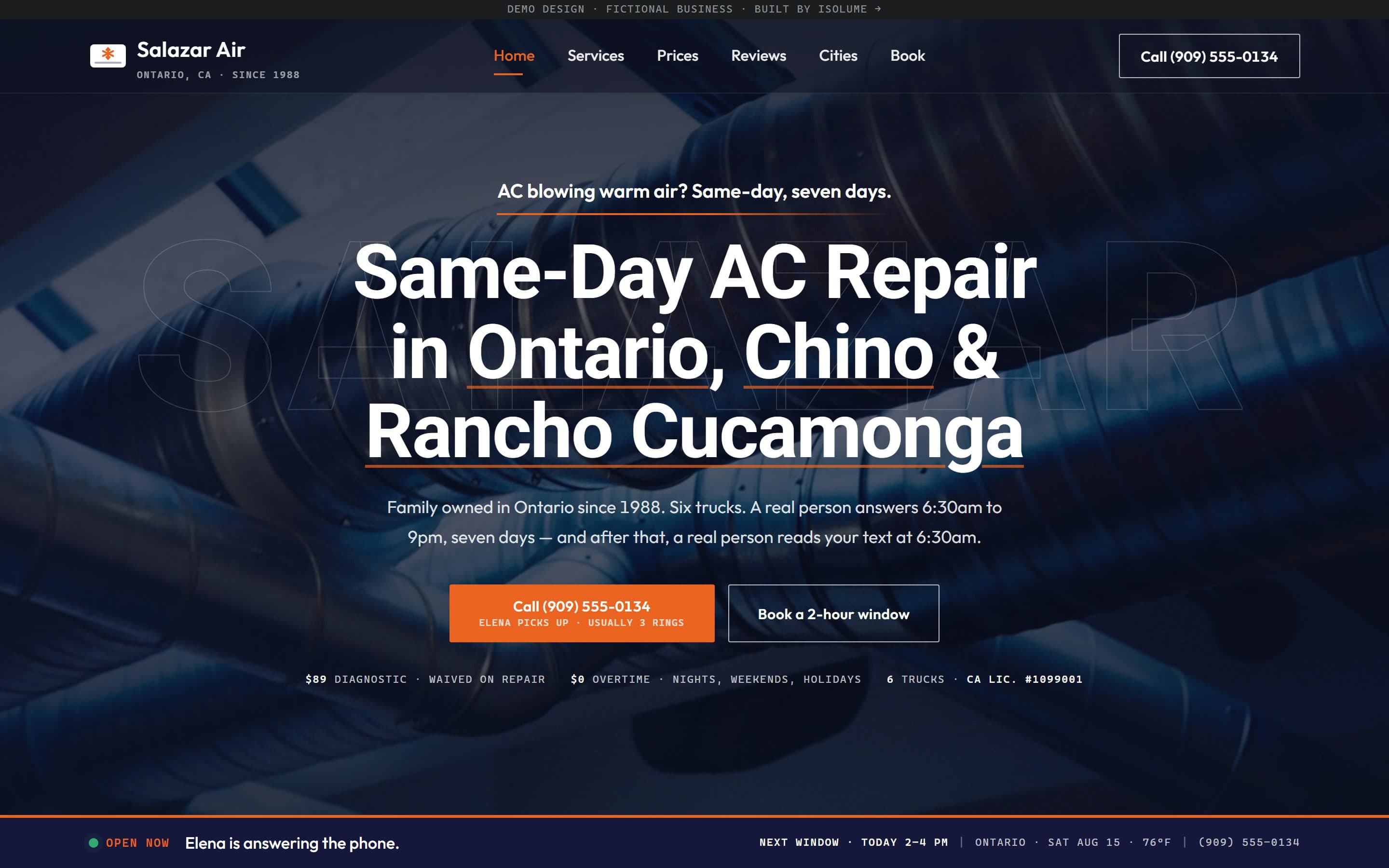
Salazar Air Conditioning & Heatingdoes not exist · the website does
Questions we get asked
- Most of my work is referrals and the lead apps. Do I need a website at all?
- Check before you spend anything. Open your analytics and look at two numbers: direct visits, and searches for your business name on its own. Those are people who already had your name and went looking anyway, which is what a referral checking you out looks like from the inside. The site either survives that check or it does not. What it will not do is replace the lead apps overnight — it earns its keep slowly, by converting the calls you already get and by giving Google somewhere to send people searching your trade and your city. And if your trucks are full and you cannot hire, that is a staffing problem, and a new website will not touch it.
- Isn't my Google Business Profile more important than my website?
- For the map pack, yes, and that is where your first hour of effort should go — the profile, the photos, the reviews. But the profile has a link on it, and the link is where the deciding happens. A strong profile pointing at a slow, vague site just delivers people efficiently to the moment they change their mind. The profile gets you seen; the site gets you called.
- Should I publish my prices?
- A range, not a quote. Publish what the diagnostic costs, publish the bands your common repairs actually land in, and put one sentence under them saying the customer approves a written price before any work starts. A flat number gets undercut line by line and gets argued with in a driveway. Silence gets read as expensive. If your work genuinely varies too much for a band — commercial, custom fabrication — publish what the visit costs and stop there.
- Can I change the seasonal special myself, or do I have to email you?
- You change it. On a build like this the coupon, the hours and the service area live in one place made to be edited, because the number a shop most wants to change is the one on the seasonal tune-up, and having to email somebody to change it is the exact thing that makes owners hate their last agency. The code is yours either way — if you ever leave us, the site goes with you and nothing goes dark.
Tell us about your hvac and trades businesse
Fifteen minutes on a call. You will leave knowing what it would cost and how long it would take, whether or not you hire us.