Industriesprivate aviation and charter operators
Private aviation website design: the sale happens in silence
Above a certain price the buyer does all the work before you know they exist, so the website is not a lead form — it is the entire sales conversation, held in advance, with someone you cannot see.
One thing separates this vertical from every other trade we write for. The reader decides alone, without ever identifying themselves, and you almost never get to answer them. Everything below follows from that, including the parts that contradict what we would tell a plumber.
Sound familiar?
- A quote request arrives already naming the aircraft, the date and a number, from somebody you have never heard from before.
- You find out you lost a trip when a broker mentions it in passing, and nobody ever tells you why.
- The inquiries you get are the ones the site should have filtered out, and the ones you wanted never wrote.
- Your best month and your worst month look identical in analytics, and neither one matches what the phone did.
You will never hear the objection that lost you the trip
A charter buyer's research happens out of your sight. They read your fleet page, your safety page and whatever terms you publish, do the same for three other operators, form a complete opinion, and act on it. If the opinion is bad, nothing happens. No email, no question, no bounce you can interpret. The trip goes elsewhere and nobody tells you.
That asymmetry inverts what a website is for. At a small ticket the site starts a conversation somebody finishes on the phone, where you can hear a hesitation and answer it. Above a certain number the conversation is over by the time they call. They contact you once, to confirm a decision made without you, or they never contact you at all.
So the page is not a lead-capture device. It is the sales conversation held in advance, in writing, with a reader who cannot be interrupted and cannot be asked a follow-up question. Every objection you would normally handle out loud has to be handled before it is raised, by a page that does not know who is reading it.
Which is why "contact us for details" does more damage here than anywhere else, and why the vertical keeps it anyway. It reads as a price you would rather explain than publish. A buyer with three tabs open takes it as the answer being bad, and closes the tab. That costs you nothing you can measure and everything you cannot.
You can check this against your own inquiries instead of taking our word for it. Read the last twenty and count how many arrived already naming an aircraft class, a date and a rough figure. Those people did not learn that on the call. If it was not on your site, it was on somebody else's.
Every number you leave off gets filled in with the worst one
Silence is not neutral. A reader who cannot ask does not wait for an answer — they supply one, and the one they supply is the least flattering thing consistent with what you published. A missing rate becomes the highest they have seen. An unnamed aircraft becomes whatever was cheapest that week. An operator who does not say whether it holds the certificate becomes a broker.
An hourly rate on its own leaves out a two-hour daily minimum, the 7.5 percent federal excise tax, a per-passenger segment fee, landing and handling at both ends, and the crew's hotel overnight. Anyone who has chartered before knows all of it is coming. Printing it costs you the flattering number and buys the one thing that matters at this price: your first figure and your invoice match.
Print who you actually are, too. A broker's site can read exactly like an operator's. Naming which tails you hold on your own certificate and which you source from someone else's is the plainest sentence available in this vertical. So is linking to the safety registries that audit you, at the registry itself rather than at a badge you drew. An audit a stranger can look up outranks any adjective.
Then there are the terms you would normally save for the closing call. If your card costs more on peak days, name the peak days, with dates. If the excise tax applies to the card as well as to charter, say so on the page that sells the card. If hour twenty-six re-prices as an ordinary charter, print that in the same type as the rate.
And print the constraint that otherwise arrives as a complaint. John Wayne's General Aviation Noise Ordinance drops the permitted single-event noise so far between 10 p.m. and 7 a.m., 8 a.m. on Sundays, that ordinary business jets cannot legally depart. That is a checkable fact, published on the airport's own site. Your reader finds it on your page or at the worst possible moment, and only one of those is your decision.
Nobody charters a jet by searching near me
This is the one page on our site where we will not tell you to invest in local search. A homeowner with a dead air conditioner types a city name. A charter buyer does not. They search a route, an aircraft class, an operator's name, or they arrive from a comparison somebody else assembled. Proximity is not the filter here. The certificate, the aircraft and the total are.
We are an Orange County studio and we work remotely, so be clear about the geography. For an operator at John Wayne, a local page earns its keep for hiring, for vendors, and for the client who genuinely searches by airport. It will not win a Cabo trip against an operator at Van Nuys. The pages that earn are about the routes you fly and the aircraft you put on them.
Expect your analytics to describe this audience badly, and plan around it rather than arguing with it. One buyer researching across two weeks — office desktop, phone, sometimes an assistant's browser, on a corporate network that strips tracking — arrives in your reporting as several unrelated strangers, or as none. The last click before the form takes credit for a decision made a week earlier on the fleet page.
Trust the things people tell you without being asked. Put one open field on the inquiry form asking what they read before writing, and read the answers as sentences rather than counting them. Notice which pages turn up inside the questions you get. Watch the shape of the inquiries change: when the page starts working, the vague ones thin out and the rest arrive naming a tail, a date and a number.
One last thing about the form, since the argument has been that the decision is made before anyone touches it. Keep it short and make the page around it long. The form is where a decision gets recorded, not where it gets made. Every extra field can lose somebody who had already decided, and every fact left off the page is a decision that never got made.
See it built
Halyard Jets is a fictional company. There is no such operator — the name, the tail numbers, the phone numbers and the Santa Ana address are invented, and the footer of every page says so — while the airport rules, tax rates, aircraft specifications and distances on it are real and each carries its source. We built it because this argument cannot be made on a real operator's site. We built it because the argument needs numbers no operator publishes — the daily minimum, the excise tax, the landing and handling, and a break-even sheet that can tell a prospect the card is the wrong product for them. Every one of those is a figure a real charter site saves for the closing call. Its fleet page prints every aircraft with the manufacturer's spec sheet, the hourly rate, whether the tail is operated on the company's own certificate or brokered from somebody else's, and a link to the source behind each number. Its card page dates all twelve peak days for the current year and prices twenty-four months both ways, charging the whole card rather than only the hours flown, and naming the winner even when the card loses.
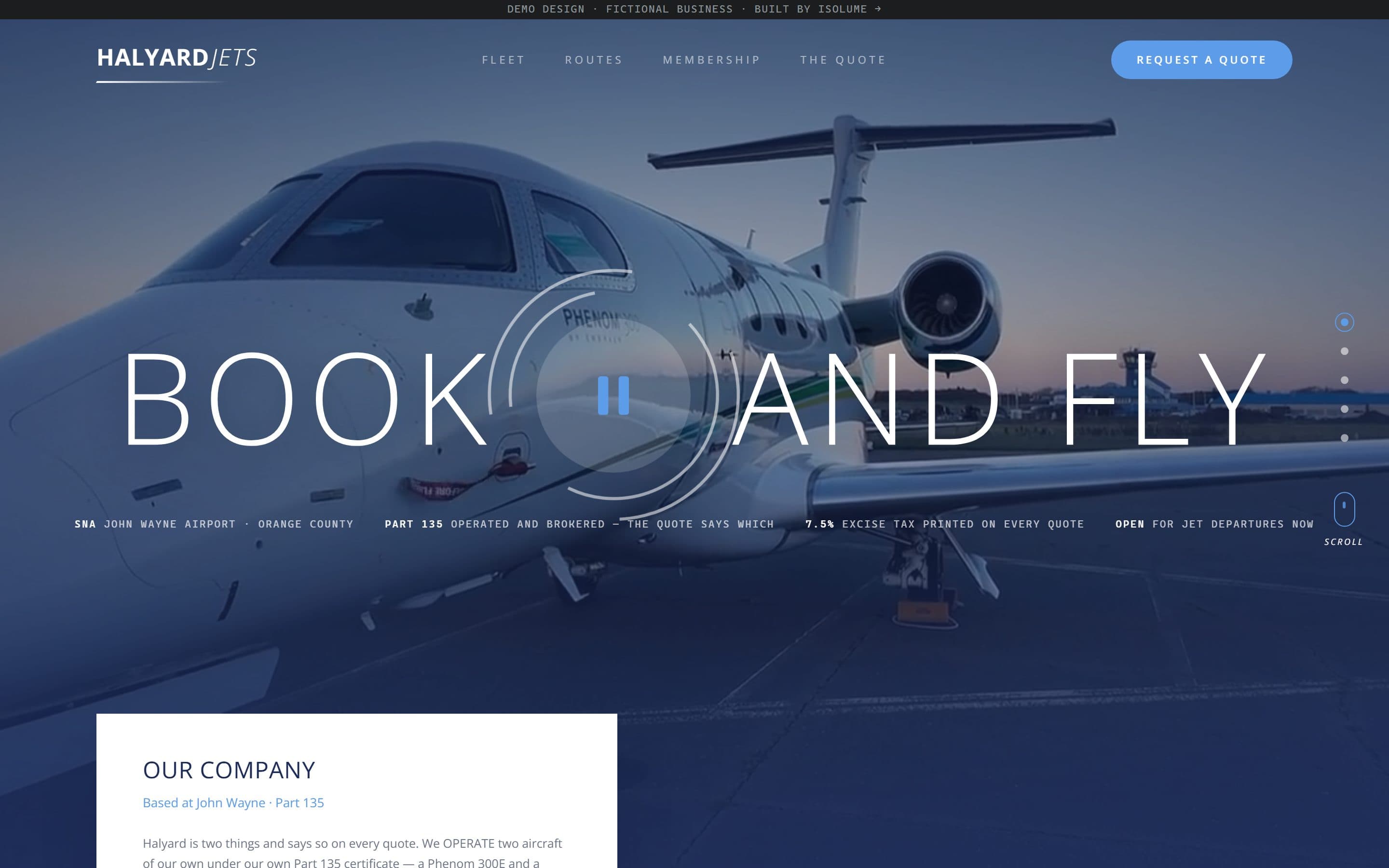
Halyard Jetsdoes not exist · the website does
Questions we get asked
- Should we publish our hourly rate?
- Publish something that survives arithmetic. An hourly rate on its own is the number that starts arguments, because it is not what anybody pays — the daily minimum, the excise tax, the per-head segment fee and the handling all land after it. Two things work better than a bare rate. One is a fully worked total for a route you fly every week, every line shown. The other is an instrument that computes it: pick an aircraft and a destination, and the page derives the block time from the distance, applies the minimum, adds the tax and the fees, and prints one figure. That is a calculator rather than a checkout — availability still needs a person — and it answers the question a buyer would otherwise have to write in to ask.
- Won't publishing our numbers just let competitors undercut us?
- Anyone who wants your rate can call the desk with an invented trip and have it inside ten minutes, so the person your silence keeps in the dark is the buyer. What publishing costs you is the option of quoting the same trip two ways for two customers, which is worth deciding on its own merits. What it buys is the reader with three tabs open who picks the one where the total is already visible, because that is the tab where nothing is going to be added later.
- We broker most of our lift. Is it safer to stay vague about that?
- Vagueness is safer for one conversation and expensive across all of them. Buyers at this level understand the difference between a certificate holder and a broker, and they will establish which you are — from a registry, from the tail number on the trip sheet, from a competitor happy to explain it. Saying it first turns a discovery into a disclosure. Brokering is a legitimate business. Being caught implying otherwise is a different problem, and it lands after you have somebody's money.
- Nearly all our work comes through brokers and referrals. Does the website matter?
- It gets looked up. Not usually by the client — by the broker's ops desk maintaining an approved-operator list, and by whoever at the client's end has to justify the choice afterwards. Neither of them will write to you. They open the fleet page, look for the certificate and the tails, and either you stay on that list or you come off it without a conversation. Nothing on a website makes somebody need a jet, so if your tails are already full, the money belongs in lift.
- Can we tell which pages produce the high-value inquiries?
- Less precisely than you would like, and the gap is worth understanding before you make budget decisions with it. This audience researches over weeks, across devices and networks, some of which strip tracking entirely. What you get is a last click, usually to a page that had nothing to do with the decision. Add the open field to the form, read the answers, and give a slow page a year before judging it. Deleting the page that did the persuading because the analytics credited the contact page is the mistake this reporting sets you up to make.
- Do we need Orange County SEO at all?
- Some, and less than any other business we write pages for. A local page is useful for hiring, for vendors, and for the client who genuinely searches by airport. It is not where the charter decision happens, and treating it as the main event is how an operator ends up with a beautifully optimized page nobody in their market was ever going to type. Put the work into the routes, the fleet and the terms, because those are what a buyer compares when geography is not one of the criteria.
Tell us about your private aviation and charter operator
Fifteen minutes on a call. You will leave knowing what it would cost and how long it would take, whether or not you hire us.