Industriesfood and beverage brands
Food brand website design: where the claim gets checked
A pack makes claims and the website is where a stranger checks them, so the page is only worth building if the checking can succeed.
Food and beverage brands are not found by proximity and are not hired over the phone. They are picked up, put back, looked up, and bought a second time or not. We design and build the pages that decide the second purchase, in real code, for brands whose customers are wherever the shelf happens to be.
Sound familiar?
- A stranger screenshotted your sustainability number and asked, in public, where it came from.
- Your ingredient list is a photograph of the back of the carton, and people email to ask what is in it anyway.
- A grocery buyer asked you something your website answers, four pages in.
- Where to buy is a wall of retailer logos, and not one of them tells a shopper which store has you.
Every visit is somebody auditing a claim
By the time somebody types your brand name, they have already met the claim. They read it off a pack, or saw it in an ad, or heard it from a friend who sounded certain. They are not discovering you. They are checking you, and they stop as soon as they find the evidence or the gap.
Nothing about this reader is local. A carton travels to whoever stocks it, so the audience is defined by distribution rather than by drive time. Most of what we build is found by proximity — a plumber's customer is inside a drive. Yours is wherever a shelf is, which means there is no urgency to design around and no phone button that helps.
Instead there are four kinds of claim. Each costs the reader a different amount to check and each costs you something different to publish. That trade is the brief.
What is in it: the claim with a statute behind it
The cheapest claim to check, and the one with the most riding on it for whoever checks. Somebody with a milk allergy. Somebody avoiding soy. A parent reading a label for a child.
The nutrition panel and the ingredient list belong on the page as real text. A photograph of the carton back makes a reader pinch and drag to find one word, and it keeps your ingredients out of the searches that would have brought people to you.
You can size that gap in your own inbox: read three months of contact-form messages and count the ones asking something the pack already answers. Each is a page you have not written.
The stricter version is to publish the part that costs you. The demo prints the milk-allergen warning on the carton front rather than the back, and cites the regulation instead of paraphrasing it — the FDA response letter for fermentation-made beta-lactoglobulin, GRAS Notice GRN 000863, and 21 CFR 131.110, the standard of identity governing what may be called milk. A citation sends the reader somewhere that is not your website.
What it does to the world: the claim nobody can check alone
Every food category has a favorite number — lower emissions, less water, fewer ingredients. It is also the claim a reader cannot verify at a price they are willing to pay; nobody runs a life-cycle assessment in a dairy aisle.
So the thing to publish is not a bigger number. It is where the number came from. Find the study behind your largest claim and read who commissioned it. If the party that paid for the work is the party that sells the ingredient, that is a fact about the study rather than about your carton, and you should be the one to say it.
The demo takes the extreme version. Its label page sets a 2021 assessment commissioned by the company that sells the protein beside the peer-reviewed comparison that disagrees with it — Behm et al. 2022, Int J Life Cycle Assess 27:1017–1034, which found footprints of the same order as dairy — then declines to print any percentage in its own hero.
Publishing the number that hurts you is the one thing a website cannot fake.
What it costs: the claim a shopper checks with arithmetic
Price is the fastest claim to audit and the one brand sites are shyest about. A pack price on its own is not the figure a shopper is comparing. The shelf tag beside your carton prints price per ounce, because that is the figure somebody comparing two pack sizes needs.
Work yours out now: pack price divided by ounces in the pack. If the answer is uncomfortable, the pack size is the problem, and leaving it off the site does not change the pack.
The demo prints cents per fluid ounce on every card. Its cost sheet prices whatever basket you built against oat, almond and soy, using those brands' published panels and one retailer's listing for each — per glass, and per twenty-five grams of protein. Against soy it loses on both counts and says so in the same voice it uses when it wins. The rule written into that file is blunt: an instrument that only ever recommends the product is a brochure.
Where to buy it: the claim that goes wrong while you sleep
The first three claims are true or false the day you write them. This one is written by other people. A chain resets a planogram, the line comes off shelves you have never stood in, and your page keeps saying what it said in March. Checking it costs a reader a drive, so a stale store list does more damage than none.
The usual version is a marquee of retailer logos, which tells a shopper nothing: a chain has hundreds of stores and a few of them have you. The useful version is narrower — which shop, how far, which aisle, and when somebody last looked. Compute the miles from a ZIP the visitor types; distances typed into a field rot by the second week. Straight-line miles are the only distance a website can honestly claim to know, and the demo says so rather than inventing a drive time.
Print the date the shelf was last walked and the reader decides how much to trust the row. Then audit your own: call three shops on your locator and ask whether they have you this week.
See it built
MOOT is a fictional animal-free dairy brand. We invented the company, the flavors, the prices and the twenty Orange County shops that stock it, and every page of the demo declares that. It had to be fictional, because no real brand signs off on a page that prints the peer-reviewed study disagreeing with its own category's headline claim, or on a cost sheet that hands the win to soy. A made-up one signed off on both in an afternoon. What is not invented is the regulatory spine: the label page cites the real FDA notice and the real standard of identity, and links to each.
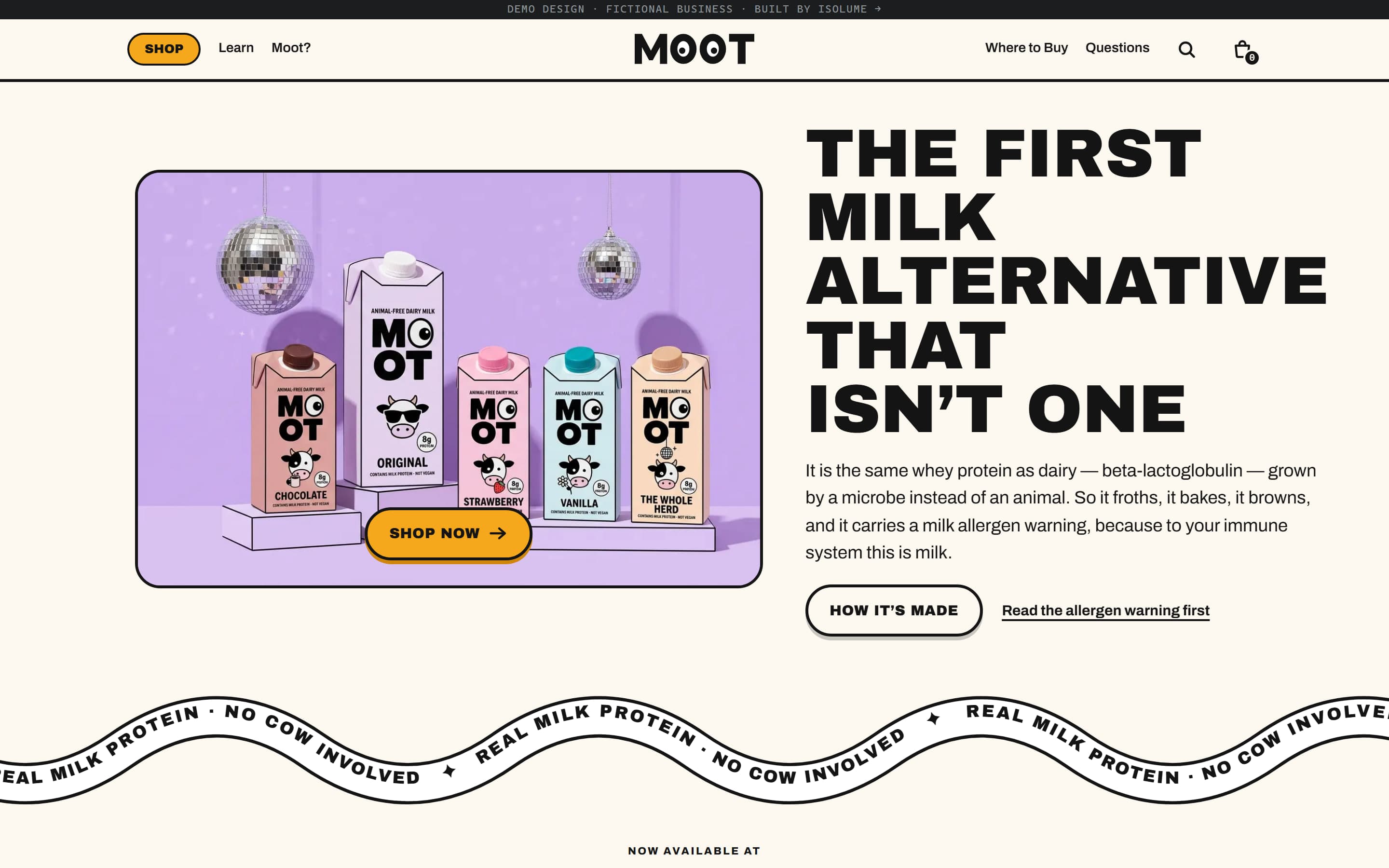
MOOT — Animal-Free Dairydoes not exist · the website does
Questions we get asked
- Should we sell direct from the site?
- Direct sales are a fulfillment operation — packing, cold chain, breakage, returns, the phone call about a leaking box — and the website is the smallest part of it. If your product moves through retail today, a store finder that names the aisle is worth more than a checkout that ships one crushed case and issues a refund. The demo has no checkout at all; its cart costs the basket and then points at the nearest shop that stocks it. When shipping is genuinely ready, adding a checkout is ordinary work and we will build it then.
- What do we do about a sustainability claim we cannot prove ourselves?
- Publish the provenance instead of the number. Name who ran the study, who paid for it, and what the study says about its own limits — those documents are usually more careful than the brands quoting them. If independent work disagrees, print that beside it. You give up the strongest version of the claim and you gain the one position that survives a screenshot: you said the awkward part first.
- We are one product in a dozen shops. How big should the site be?
- Smaller than most people will quote you for. A page that sells the product, a label page, and a store list is a complete website for a single-SKU brand. Eleven pages built around a product line that does not exist yet age badly, and four abandoned blog posts date a brand faster than no blog. If a studio's first question is a page count rather than what each page has to do, that tells you something before you sign anything.
- We do not have product photography yet. Can we launch?
- Photography arrives late and usually one flavor at a time, so the build should assume its absence rather than wait on it. Each pack slot holds an illustration now and swaps to a photograph later at the same size, in the same place, with nothing around it moving. On the demo, the sixth carton went from drawn to photographed in an afternoon. You launch on the schedule your business has instead of the one the shoot has.
Tell us about your food and beverage brand
Fifteen minutes on a call. You will leave knowing what it would cost and how long it would take, whether or not you hire us.